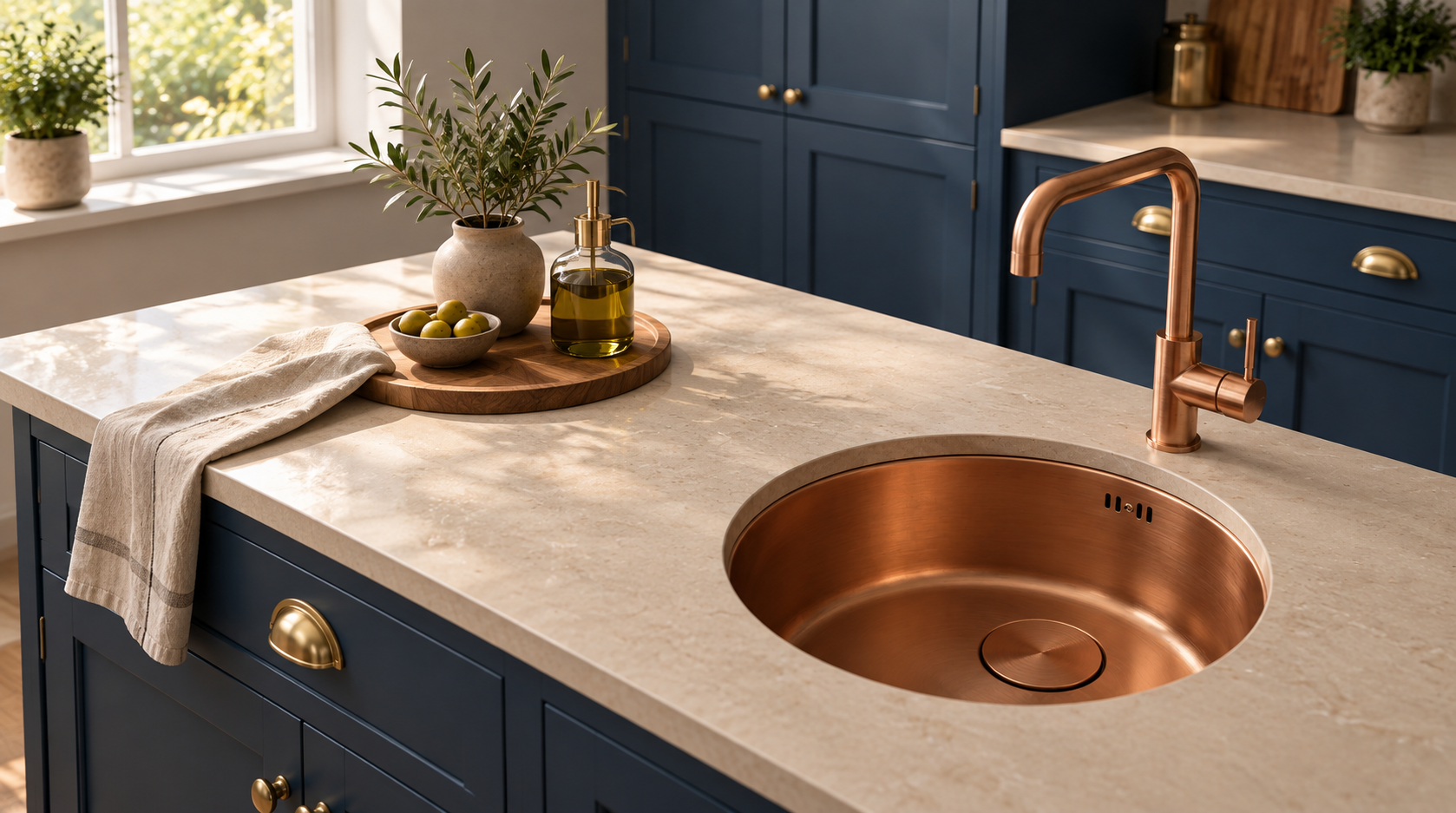
Choose a round sink over a rectangular one when the counter run itself is narrow, typically under 55-60cm deep, since a round bowl's diagonal capacity lets it hold nearly as much as a rectangular sink in less front-to-back depth. Choose rectangular when you regularly wash long items (sheet pans, roasting trays) that need a straight edge to rest against. The shape decision comes down to what you actually wash and how much counter depth you have, not which one looks more current.
Why Shape, Not Just Size, Matters in a Small Kitchen
Most small-kitchen sink advice focuses on overall size, get a smaller sink to save space, without addressing that a round and a rectangular sink of similar volume take up counter space differently. A rectangular sink's usable width runs edge to edge in a straight line, so its full footprint is committed to the sink regardless of what's in the basin. A round sink's corners, which a rectangular basin has and a round one doesn't, are exactly the space you get back: the countertop around a round sink's curve has usable corner space a rectangular sink's square footprint doesn't leave.
This matters most in a galley kitchen or a narrow run of counter, where every centimeter of front-to-back depth is contested space between the sink, the backsplash, and the counter edge.
Where a Round Sink Genuinely Wins
Narrow counter depth. A standard kitchen counter runs 55-60cm deep. A rectangular sink needs enough of that depth to accommodate its full basin plus a lip on each side for the counter surface, often leaving very little clearance front-to-back. A round sink's diameter can be sized to fit that same depth with more margin on either side, since its shape doesn't need the same rectangular footprint to hold a comparable basin volume.
Corner or diagonal installations. In a kitchen where the sink sits at an angle to make use of a corner, a round sink's symmetrical shape fits that geometry more naturally than a rectangular sink, which needs careful counter templating to avoid an awkward angled cut.
A single-cook workflow. If the kitchen is mostly used by one person at a time and the tasks are washing produce, filling pots, and rinsing dishes rather than soaking large bakeware, a round sink's central drain and even depth handle those tasks as well as a rectangular one, without needing the extra length.
Visual flow in a small room. A round sink breaks up the straight lines that dominate a small kitchen, counter edges, cabinet fronts, appliance faces, which can make a tight space read as less boxy. This is a secondary benefit, not the deciding factor, but it's a real one in a kitchen where every surface is a hard-edged rectangle already.




Where Rectangular Still Wins, Even in a Small Kitchen
Long or flat items. A sheet pan, a roasting tray, or a large cutting board needs a straight edge to rest against while soaking or rinsing. A round sink's curved walls don't give a flat item anywhere stable to lean, so it either doesn't fit at an angle that works or takes up more of the bowl's usable space than it would in a rectangular basin of the same volume.
Double-bowl setups. If the kitchen's workflow benefits from separating tasks, washing on one side, drying rack or prep on the other, a rectangular double-bowl sink fits that division far more naturally than two round basins would, which typically need more combined counter width than a single rectangular double-bowl unit.
Maximizing basin volume within tight width. If the counter is narrow front-to-back but has reasonable width side-to-side, a rectangular sink makes better use of that available width than a round one, since a round sink's diameter is capped by the tighter of the two dimensions (depth), while a rectangular sink can use the wider dimension fully.
Round vs. Rectangular: Quick Comparison for Small Kitchens
|
Round sink |
Rectangular sink |
|
|
Best counter depth |
Narrow (under 55-60cm) |
Standard to deep (60cm+) |
|
Corner counter space |
Better; curve frees usable corner area |
Full footprint is committed to the sink |
|
Long/flat item washing |
Weaker; no straight edge to rest items against |
Stronger; flat items sit naturally against a straight wall |
|
Double-bowl practicality |
Poor; needs more combined width than rectangular |
Good; splits cleanly into two functional basins |
|
Diagonal/corner installation |
Fits naturally |
Needs careful templating to avoid awkward angles |
|
Visual effect in a small room |
Softens hard-edged lines |
Continues the room's existing straight lines |
Sizing a Round Sink Correctly
A round sink's single dimension, diameter, does the job that a rectangular sink's length and width do together, which makes it simpler to size but also less forgiving if you get it wrong.
- 35-40cm diameter: suits a genuinely tight galley or secondary kitchen; comfortable for rinsing and light prep, tight for washing a stockpot.
- 40-45cm diameter: the more common choice for a small primary kitchen; workable for most daily tasks including moderate-sized cookware.
- 45cm and above: starts to lose the small-kitchen space advantage, since a round sink at this size needs nearly as much counter depth as a compact rectangular sink would, without the straight-edge benefit for flat items.
Check the diameter against the counter's actual depth, not just its length, since depth is the dimension a round sink is usually chosen to solve.
Installation Considerations
Round sinks are available in the same mounting types as rectangular ones: undermount, top-mount, and flush-mount. Undermount tends to show off a round sink's shape most clearly, since there's no visible rim interrupting the curve, and it pairs well with a stone or solid-surface counter that can be cut cleanly to the sink's radius.
A round sink's drain typically sits at the center, which usually means the plumbing beneath needs less lateral offset than a rectangular sink's drain, often positioned toward one end. This can occasionally simplify cabinet layout underneath, though it depends on the existing plumbing rough-in position.


Common Mistakes
- Choosing a round sink based on style alone without checking whether the counter depth actually benefits from it
- Sizing the diameter too small to comfortably wash normal cookware, then finding daily use frustrating
- Assuming a round sink automatically saves more space than a smaller rectangular one; the saving comes specifically from freed corner space, not from the bowl itself being smaller
- Choosing a round sink for a kitchen that regularly needs to wash sheet pans or large trays, where the lack of a straight edge becomes a daily annoyance
- Overlooking drain and plumbing position under the counter before finalizing the choice
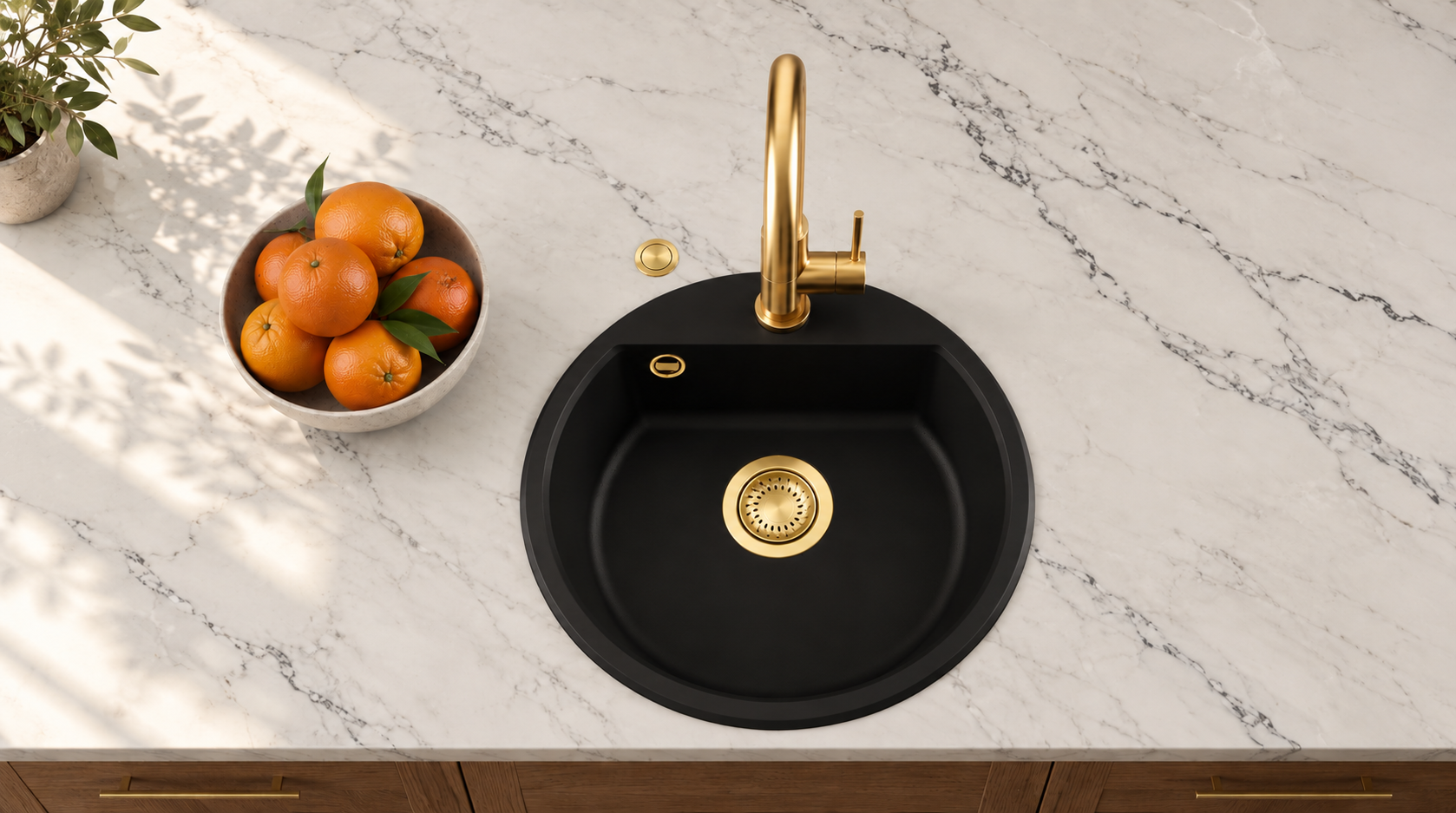
A round sink earns its place in a small kitchen when the counter is narrow front-to-back and the household's washing habits don't depend on flat, straight-edged items. It's not a universal small-kitchen upgrade, it's the right shape for a specific set of constraints, and knowing which constraints you actually have decides whether round or rectangular is the better fit.
FAQ
Does a round sink actually save counter space compared to a rectangular one?
It depends on the counter's shape. A round sink saves usable space specifically in a narrow, front-to-back-constrained counter, since its curve frees corner area a rectangular sink's square footprint would occupy. On a counter with ample depth but limited width, a rectangular sink typically makes better use of the available space.
What size round sink is right for a small kitchen?
40-45cm diameter suits most small primary kitchens for daily tasks. Under 35-40cm gets tight for washing anything beyond light rinsing; above 45cm starts to lose the space advantage that makes a round sink worth choosing in a small kitchen in the first place.
Can a round sink handle a sheet pan or large roasting tray?
Less comfortably than a rectangular sink. A round basin's curved walls don't give a flat item a straight edge to lean against, so large flat items either don't fit well at any angle or take up more of the bowl's usable volume than they would in a rectangular basin.
Is a round sink harder to install than a rectangular one?
Not inherently. It's available in the same mounting types (undermount, top-mount, flush-mount) as a rectangular sink. Undermount installation tends to suit a round sink particularly well, since there's no rim breaking up the curve.
Does a round sink work for a double-bowl setup?
Not efficiently. Two round basins typically need more combined counter width than a single rectangular double-bowl sink of similar total capacity, so rectangular remains the more practical choice for a kitchen that wants a genuine two-basin workflow.
Why does a round sink suit a corner installation better than a rectangular one?
A round sink's symmetrical shape fits an angled or diagonal counter cutout naturally, without the careful templating a rectangular sink needs to avoid an awkward angled edge where it meets the counter's cut line.


